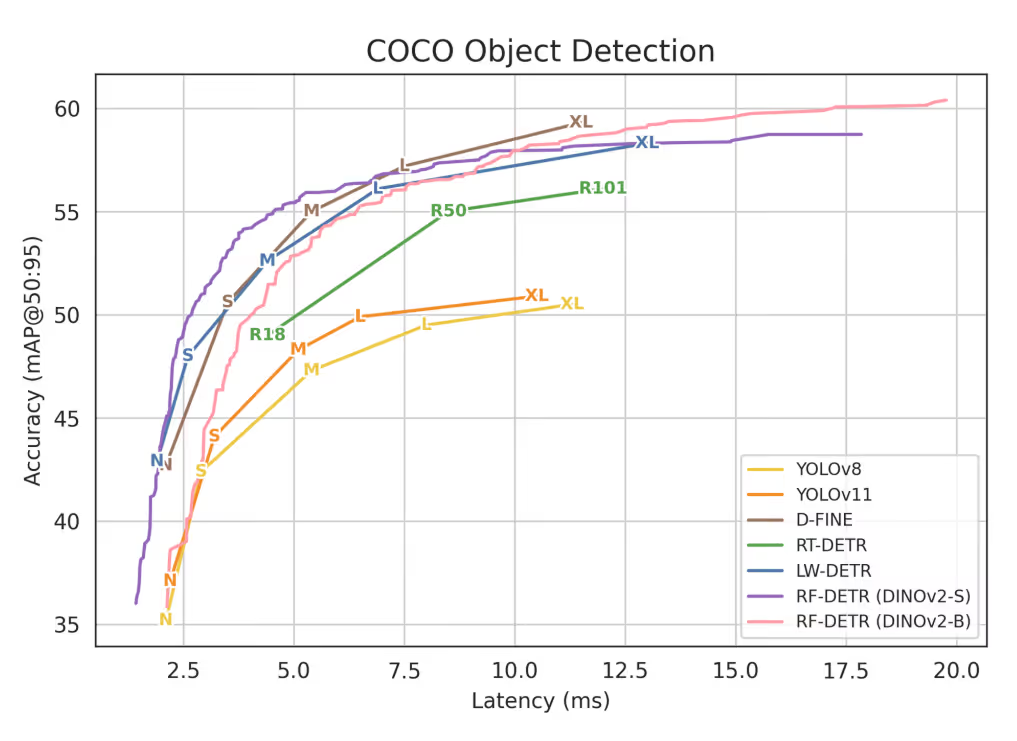
YOLOv8 is a computer vision model architecture developed by Ultralytics, the creators of YOLOv5. You can deploy YOLOv8 models on a wide range of devices, including NVIDIA Jetson, NVIDIA GPUs, and macOS systems with Roboflow Inference, an open source Python package for running vision models.
This document provides a complete blueprint for constructing a ZX Spectrum VGA adapter. Adjust as needed for specific Spectrum models and monitor compatibility.
void vga_output() while(1) if (frame_ready) // Generate VGA frame using line doubling for (int y=0; y<480; y++) int src_y = (y - 48) / 2; // center if (src_y < 0 frame_ready = false;
// Pseudo-code for RP2040 frame buffer VGA converter uint8_t framebuffer[192][256]; // 8-bit color volatile bool frame_ready = false; void capture_frame() // Wait for VSYNC from Spectrum while(gpio_get(HSYNC_PIN)); for (int y=0; y<192; y++) for (int x=0; x<256; x++) (g<<1) zx spectrum vga
| Pin | Signal | Description | |-----|--------|----------------------| | 1 | GND | Ground | | 3 | +5V | Power | | 15 | RED | TTL (0/5V) | | 16 | GREEN | TTL | | 17 | BLUE | TTL | | 18 | CSYNC | Composite sync (TTL) |
| Region | Pixels | Time @ 25.175 MHz | |---------------|--------|-------------------| | H-sync pulse | 96 | 3.81 µs | | Back porch | 48 | 1.91 µs | | Active video | 640 | 25.42 µs | | Front porch | 16 | 0.64 µs | | Total | 800 | 31.78 µs (31.47 kHz) | This document provides a complete blueprint for constructing
Example for red channel:
The Spectrum’s 192 active lines are doubled to 384, then placed inside the 480 active lines with 48 black lines above and below. The Spectrum produces 8 colors (3 bits: R, G, B each 0/5V). After level shifting to 3.3V, drive three R-2R ladders (e.g., 1k/2k resistor networks) to produce ~0.7V full scale into 75Ω VGA inputs. The Spectrum produces 8 colors (3 bits: R, G, B each 0/5V)
The 48K Spectrum only has composite. The 128K models provide separate TTL-level RGB signals (0V = black, +5V = full intensity) and composite sync on the edge connector. For a clean VGA conversion, use a 128K model or add a composite-to-RGB decoder (e.g., using a LM1881 sync separator). | Parameter | Value | Tolerance | |------------------|---------------------------|-------------| | Horizontal scan | 31.46875 kHz | ±500 Hz | | Vertical scan | 59.94 Hz | ±0.5% | | Pixel clock | 25.175 MHz | ±0.5% | | H-sync polarity | Negative | | | V-sync polarity | Negative | | | Active pixels | 640 | | | Active lines | 480 | |
This document provides a complete blueprint for constructing a ZX Spectrum VGA adapter. Adjust as needed for specific Spectrum models and monitor compatibility.
void vga_output() while(1) if (frame_ready) // Generate VGA frame using line doubling for (int y=0; y<480; y++) int src_y = (y - 48) / 2; // center if (src_y < 0 frame_ready = false;
// Pseudo-code for RP2040 frame buffer VGA converter uint8_t framebuffer[192][256]; // 8-bit color volatile bool frame_ready = false; void capture_frame() // Wait for VSYNC from Spectrum while(gpio_get(HSYNC_PIN)); for (int y=0; y<192; y++) for (int x=0; x<256; x++) (g<<1)
| Pin | Signal | Description | |-----|--------|----------------------| | 1 | GND | Ground | | 3 | +5V | Power | | 15 | RED | TTL (0/5V) | | 16 | GREEN | TTL | | 17 | BLUE | TTL | | 18 | CSYNC | Composite sync (TTL) |
| Region | Pixels | Time @ 25.175 MHz | |---------------|--------|-------------------| | H-sync pulse | 96 | 3.81 µs | | Back porch | 48 | 1.91 µs | | Active video | 640 | 25.42 µs | | Front porch | 16 | 0.64 µs | | Total | 800 | 31.78 µs (31.47 kHz) |
Example for red channel:
The Spectrum’s 192 active lines are doubled to 384, then placed inside the 480 active lines with 48 black lines above and below. The Spectrum produces 8 colors (3 bits: R, G, B each 0/5V). After level shifting to 3.3V, drive three R-2R ladders (e.g., 1k/2k resistor networks) to produce ~0.7V full scale into 75Ω VGA inputs.
The 48K Spectrum only has composite. The 128K models provide separate TTL-level RGB signals (0V = black, +5V = full intensity) and composite sync on the edge connector. For a clean VGA conversion, use a 128K model or add a composite-to-RGB decoder (e.g., using a LM1881 sync separator). | Parameter | Value | Tolerance | |------------------|---------------------------|-------------| | Horizontal scan | 31.46875 kHz | ±500 Hz | | Vertical scan | 59.94 Hz | ±0.5% | | Pixel clock | 25.175 MHz | ±0.5% | | H-sync polarity | Negative | | | V-sync polarity | Negative | | | Active pixels | 640 | | | Active lines | 480 | |
You can train a YOLOv8 model using the Ultralytics command line interface.
To train a model, install Ultralytics:
Then, use the following command to train your model:
Replace data with the name of your YOLOv8-formatted dataset. Learn more about the YOLOv8 format.
You can then test your model on images in your test dataset with the following command:
Once you have a model, you can deploy it with Roboflow.
YOLOv8 comes with both architectural and developer experience improvements.
Compared to YOLOv8's predecessor, YOLOv5, YOLOv8 comes with:
Furthermore, YOLOv8 comes with changes to improve developer experience with the model.